Why Do Stainless Steel Water Cups Still Rust? (Part 1)
Stories reside in every cup, warmth fills daily life. Hello everyone, and welcome back to "Dong Dong's Cup Talk". Recently, I noticed a steady drop in the indexed pages of our company website. Upon further investigation, I found numerous previously included articles had been removed, flagged as AI-generated content, which is truly frustrating.
I started writing industry and product-related articles back in 2020, long before AI writing tools became prevalent. When early AI products emerged, we even ran tests on them. Surprisingly, https://www.umbottle.com/ProductsDetail-VB-10435.htmlsome content generated by those AI tools was actually copied from my writings. Unable to change the platform rules against AI content, I have to rewrite all the deleted articles. On the bright side, this gives me a chance to reflect on my past writing shortcomings. With years of accumulated professional expertise, I can now present the same topics in a more comprehensive way.
Today, let’s revisit a common question: why do stainless steel water cups develop rust? I run accounts under the same name across multiple social media platforms, and I’ve received countless messages on Xiaohongshu about rusty stainless steel cups. Most people wonder how a product labeled "stainless steel" can rust at all. Let me clarify this first: stainless steel only resists rust, it is not completely rust-proof. Every material has its performance limits. Once pushed beyond its tolerance, it will inevitably malfunction.
I’ve summarized five major causes of rust on stainless steel water cups. I will elaborate on each cause in separate articles due to the length of the content. Follow my account for full details, and feel free to give a like if you find this content helpful.
Cause 1: Substandard Materials — Deceptive Material Substitution by Manufacturers
This is the most prevalent, exasperating and unethical practice. To cut costs and secure low-price orders, some manufacturers use non-compliant stainless steel instead of food-grade stainless steel for mass production. Rust is an inevitable result under such circumstances.
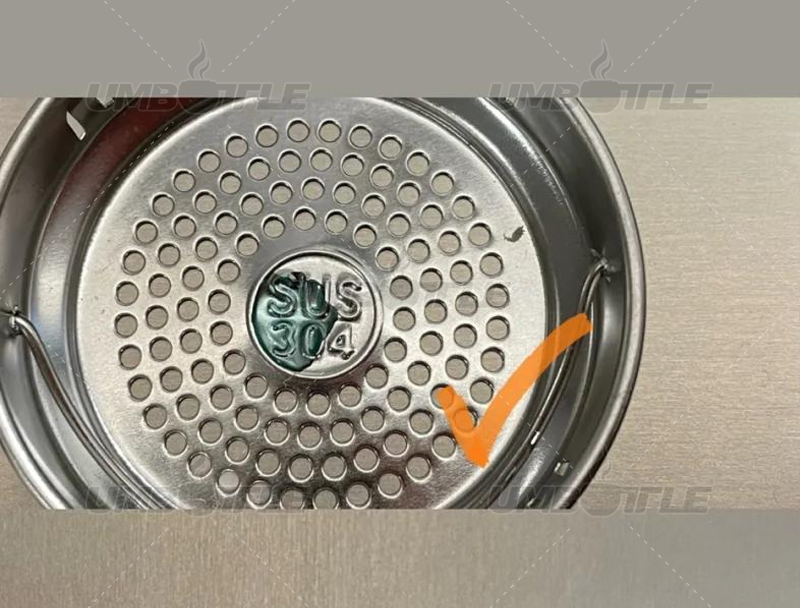
First, let’s get a key fact straight: 304 and 316 stainless steel are the mainstream food-grade materials for water cups. https://www.umbottle.com/ProductsDetail-VB-10435.htmlBoth feature excellent corrosion resistance and safety, and rarely rust under normal use. However, some unscrupulous manufacturers counterfeit these materials with 201 stainless steel or other non-food-grade austenitic stainless steel. Some even falsify material markings — labeling products as 316 while the actual material fails to meet 304 standards.
What’s wrong with 201 stainless steel? It is never designed for food contact. It contains high manganese content and poor corrosion resistance. It may seem fine holding tap water for a few days, but it will soon rust and darken when filled with hot water, tea or slightly acidic drinks. Worse still, it may release harmful substances that endanger health.
From the photos sent by followers, some cups showed obvious discoloration after just one hour of soaking in tap water: the soaked part turned dark while the rest remained unchanged. This indicates two problems: the cup is made of inferior material, and the tap water at the user’s home may have abnormal pH levels.
As for falsely labeled 304 or 316 stainless steel, the issues lie in insufficient material purity or adulteration with low-grade metals. Such unqualified products are bound to rust sooner or https://www.umbottle.com/ProductsDetail-VB-10435.htmllater. It is also worth noting that even genuine 304 stainless steel varies in quality among different steel mills, and some manufacturers classify 304 steel into different grades. I will not go into technical details here.
Tips to Avoid Low-Quality Products
Do not just trust merchants’ claims of "304/316 stainless steel". Always check if the brand provides official material certification reports. Besides, steer clear of overly cheap cups. Given the production cost of standard 304 stainless steel cups, products priced at merely a dozen or twenty yuan are very likely counterfeited with 201 steel. Do not let petty gains lead to big losses.
Here is a simple trick: use a magnet. Standard 304 and 316 stainless steel are basically non-magnetic. https://www.umbottle.com/ProductsDetail-VB-10435.htmlIf the magnet sticks firmly to the cup, it is most probably made of 201 steel or other inferior materials — just reject it.
Regrettably, low-magnetism 201 stainless steel has already appeared on the market while I was writing this article, making this trick less reliable. It is truly a dilemma.
There are stories in the cup, and life has warmth. Choose a good factory to sell good water cups. We provide global OEM services for patented products and provide global OEM services with professional teams and high quality standards. Dongguan Zhan Yi Commodity Technology Co.,Ltd. specializes in high-quality cup and kettle products. We are willing to serve you wholeheartedly.